The paper culminates in three conclusions:
- The Erstfeld hoard is to be understood in connection with the Reuss River (not in connection with the Gotthard route).
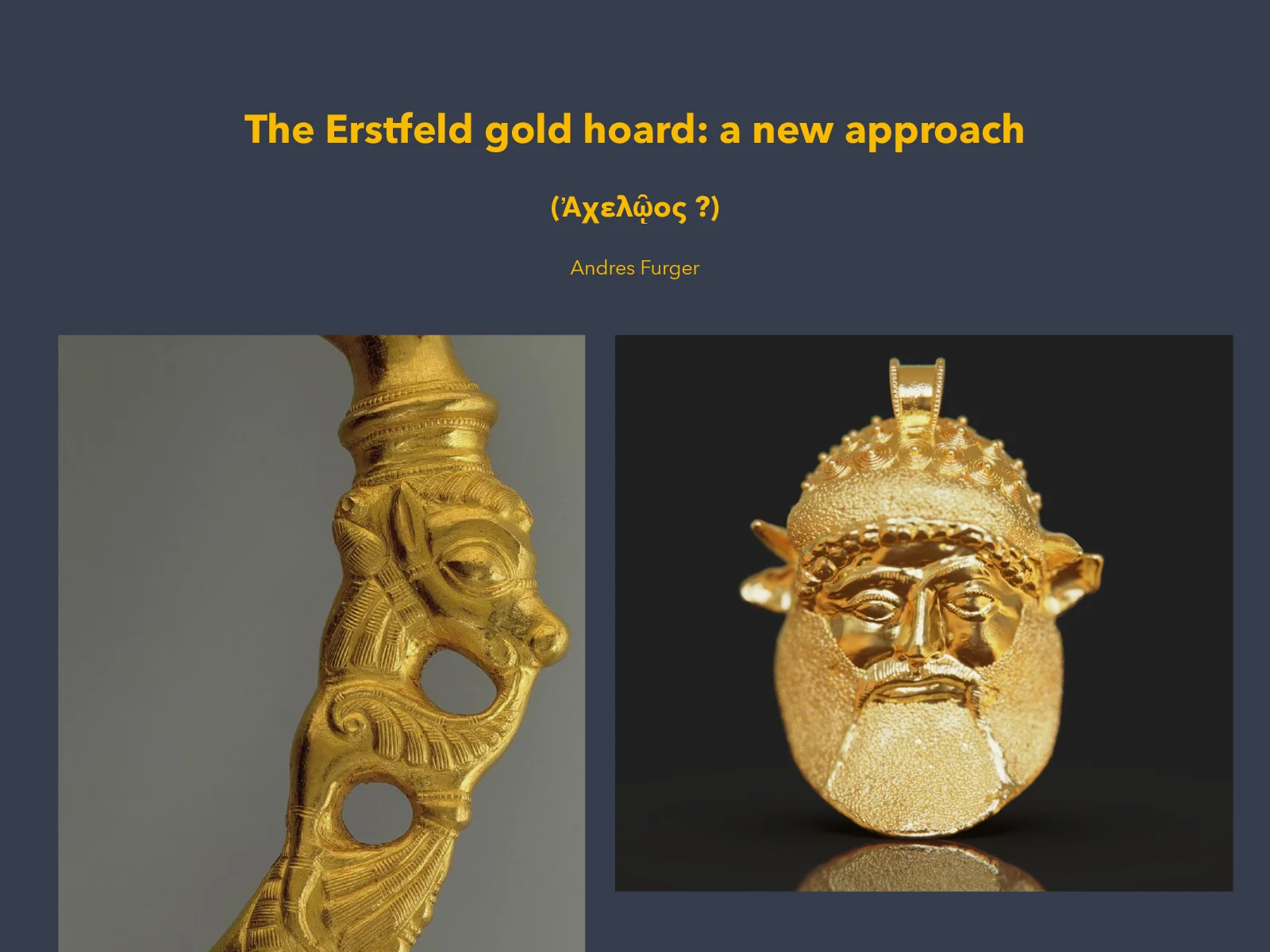
- The iconography of the Erstfeld torc 4 could represent the river god Achelous.
- The interweaving figures on Erstfeld torcs 1, 2 and 3 culminate in the central pistils as relevant symbols. As with similar rings, they lead to a better understanding of the stories behind them.
To 1
Until now, the early Celtic gold hoard from Erstfeld, dating from the 4th century BC, has been interpreted as a votive offering associated with the crossing of the Gotthard Pass. As this assumption is no longer tenable, a different approach is proposed: The offering took place at this location because the Reuss mountain stream emerges from the rugged mountains through the narrows of the Erstfeld valley and from there meanders broadly into the flat valley floor accessible from Lake Lucerne. The Reuss is the waterway that flows through a significant portion of the Swiss Plateau, fertilizing the land.
To 2
Within the framework of this new interpretation, the follow-up questions arises regarding connections to the themes of river and fertility. These themes were embodied by the river and water god Achelous (Ἀχελῷος). Achelous’ attributes were a human face with a long beard as a symbol of water, small ears and horns, and a bull's body that could transform into a snake. Against this backdrop, the bull-like masks visible on the Erstfeld torc 4 are proposed as masks of Achelous.
To 3
Finally, the three Erstfeld torcs with pictorial friezes are compared with similar gold rings. The result is thath figurative friezes culminate in the central pistils, the relevant symbols. The following question, almost implying a hypothesis, may be thus posed: Do the intertwined figures reflect stages of an epic leading to heroic status?
Digital Publication